-
 日本
日本
日本




You have to be obsessed. There's the obsession part of it, for sure. But it snowballs. Like with any craft, the more that you do it, you stay consistent with it, the better you get at it, the more that you understand it. And just the more fun it becomes because you can do more. That makes you just want to keep doing it more and more because it's more fun, it's easier, and you can do more things with it. And that's essentially what happened with guitar. Once I was like, "Oh, this is clicking," I'm starting to really improve and everything's sounding a lot better. And it made me want to keep doing it, see how far I could take it. And then now, here we are.
I've played guitar more than half my life now. Just turned 34, started taking it seriously when I was 12. And even before guitar, piano was the first one. Then drums, then violin, and then guitar. I also tried singing too, and that didn't work at all either. Took six months of vocal lessons and yeah, realized where I should put my focus, and that was definitely this thing, for sure. Guitar was just the one that worked the best, so I stuck at that one. The main reason I started playing guitar was because I wanted to write songs. Drums was my main focus. I was putting all of my effort into drums, and then I heard Train of Thought from Dream Theater. My dad and I were at Guitar Center, and there was a video of Portnoy on in the drum section. My dad was like, "What is that? Who is that guy?"
And that was just the most recent Dream Theater album out. So I started listening to that. I was trying to play all of it on drums. I just realized, "I want to be able to write stuff like this." And you can't do that only playing a percussion instrument. So I just realized, "Well, I got to learn how to play guitar." My dad's a bass player as well. That's why I play music, is because there's just all these instruments around ever since I was a kid. I've seen videos of me as a baby where I'm just pounding on a little tiny mini piano. Couldn't even walk yet. I think it was sub one years old. Just like ...
So when I decided I wanted to play guitar, my dad was like, "Oh, he's just going to move on to some other instrument, but at least I'll have a nice guitar sitting around that I'll be able to play." So he got me a Gothic black, Gibson Les Paul. It was really sick. And actually, the way we did get it was my mom was hovering the eBay listing, making sure we didn't lose it down to the last second. And she wasn't supposed to be on the website at her work, but she was doing it anyway. And that was my Christmas present when I was 12 years old. So jokes on my dad where I just ended up playing the guitar a lot, and he didn't just get to have a guitar laying around.
Guitar is a pretty important thing in my life now, that's for sure. Pays all my bills and it's like the main thing that I ... That's what I've built my name on and just another weird concept to think about to have a Music Man with my signature on it after saving up over a year to get my first Music Man when I was a teenager, just because I wanted my favorite guitar player's signature guitar.
When I heard Train of Thought from Dream Theater for the first time, that was like ... I just thought it was sick, just sounded ... It was just crazy. I just had never heard anything like that before. That set me down like a rabbit hole of just crazy metal stuff. Bands like The Faceless, Born of Osiris, Necrophagist, Children of Bodom, everything in those veins. Because then you end up finding about Yngwie, Paul Gilbert, Jeff Loomis, all those guys. I just thought it was rad. I heard how crazy all it was and was like, "I want to be able to do that, for sure. I need to be able to play guitar like this. "
Well, the first things almost any player should ever learn on guitar is just the basic, just G-C-D type stuff. I do remember my dad showing me that, and this was before I started taking guitar seriously. Because I started focusing on guitar around 12 years old. It's like full on, "This is what I'm going to do. This is the instrument I'm focusing on now." I vividly remember being shown G-C-D and thinking it was impossible and I'm never going to get it down ever. Like just sitting there trying to be like ... And then it's like, "Oh, now I have to switch to a C? Wait, and then a D? I have to do it all that quick?" I vividly remember it being the hardest thing in the world. And then probably the next thing after that, one of the first things I learned was my dad figured out how to play Dammit growing up.
Blink-182. That was the first riff probably that I ever learned. Then when I was in a local band too, there was a couple Led Zeppelin things. Oh, what's the name of that? So I think maybe it's Over the Hills and Far Away. I think that one or that one. I remember him showing me how to play that and I was just laughing that my hands were doing it. I wasn't expecting my hands to just cooperate so well with trying to do things like that. Yeah, I think that's when it clicked for me. I was like, "Oh, maybe I can play guitar." He just showed me how to play that one little thing. And I just remember laughing that my hands were like ... I did not think I'd be able to do that that quickly.
I'd only been playing guitar, taking it seriously for 10 to 11 months before I started taking lessons. The way that that ended up happening was very right place, right time kind of thing. So there was this guitar store where I grew up in Manassas, Virginia called Classic Axe, like A-X-E, like an axe. We were just in there one day and we just heard Yngwie playing from the back room, or the equivalent of literally, that crazy sounding dude named Matt Mills. And then we found out, "Oh, he gives guitar lessons." Just that was pretty much it. Started going in once a week, essentially for the next two and a half years. So I was probably 13 years old when I started taking lessons from him. He already knew that I was obsessed with Children of Bodom and Dream Theater and bands like that.
I had bad habits. I was forearm picking and a bunch of other stuff, that I definitely should not have been doing to try and play what I was trying to play. I already had a little bit of that foundation in there. I just needed my technique fixed. My first lesson with him was just like, "Here's the modes." And he's like, "Just memorize these and then we'll be able to go from there." Then I came back a week later and I had all of them memorized. And I think he literally told me, he was like, "No one's done that. I've never had a lesson where they literally come back one week later and you had every position memorized." And he was literally ... Thanked me. Because now, I don't have to just sit here wasting your parents' money for, "We sit here for a half hour and I'm trying to force you how to remember these scales just so we can move on. Because if you don't have an understanding of those, you can't progress further with theory, and just other things about how this instrument works."
My initial plan was to go to Berklee and do that whole thing there. But the only goal of that was to just go meet like-minded people and start a group with people that could play the same type of stuff that I wanted to play. Because that's the hardest part of trying to start a band no matter where you live. There has to be like two, three people at least that want to do the same thing you do, are as dedicated as you are, want it as bad enough, and can actually play it. And that's like, at least in my experience, not really possible.
When I joined All Shall Perish in 2009, I was 17 at the time. And that was from a MySpace bulletin. They posted a wanted ad and I learned a few songs in the completely wrong tuning, pitched the recordings down. My dad helped me record it on a potato handheld VCR. Someone put them up on YouTube. You can find all the videos. I sent those in not expecting any response back at all. But they emailed me back within 12 hours. That first moment where I clicked that this was happening was when I was able to go on tour with All Shall Perish. When I was 17, dropped out of high school and went on tour.
One of the first things I started to write was when I really figured out Guitar Pro, that tablature software. For me at least, being a teenager and trying to write all this crazy stuff in the vein of like Bodom, Dream Theater, Lamb of God, et cetera, I didn't know the recording aspect super well, editing and like layering parts and all that stuff. I was able to figure that out in Guitar Pro pretty quick and then get my ideas down in there. Because you could change the sounds of like synths, put in drums. So I was able to flush out full ideas in there.
I've stopped using Guitar Pro to write as much. I've intentionally made sure that that's not like my primary tool to write anymore. I don't know. I feel like you can always tell when someone uses Guitar Pro to actually write the majority of the song, because there's not a ton of subdivision changes. Everything's a little one-dimensional just because it's easier to transcribe something like that in there. It's much more of a pain in the ass to put something in that's super lyrical with a bunch of bends and having to tie the notes together and figure out all of these, like the subdivisions of something that's not just straight eighth notes or 16th notes the whole time. Now, the main thing I use as a program like Guitar Pro for, just to like expedite the writing process of like, "Hey, so if you want to come up with a crazy guitar part or shred part or something like that, you can use something like Guitar Pro to try it out before you ever even try to physically play it."
What's the point of spending three to four hours just to practice one crazy part? You get it down, you record it and you don't like it. That's a waste of time, in my opinion. When you have technology, if you learn how to use it to where you can hear this idea before you ever even try and physically perform it, to know if it's going to work or not. It's like, "Oh, should I spend this time to get this down? Is it worth that?" I have a song called Retrograde with Spencer from Periphery on vocals. There's a really crazy string-skipping part in the bridge section of the song. And I had this idea in my head. I was like, "Oh, I wonder what this lead line would sound like if I played it as if it was like a dotted-eighth delay." Just for people watching might not know what that is, it's like so if you play staccato eighth notes, like ... Or ... Just something like that, the delay fills in the gaps between every single note.
So I was just like, "I wonder what this would sound like if I just physically played every single note instead of having the delay do that." So instead of trying to just fumble around with guitar in my hand, trying to figure out exactly how all those notes would land to physically play it all instead of the delay doing it, what I did was I put the staccato eighth note part in Guitar Pro, the 16th notes with rests in between each one. Then I essentially just went and I looked a dotted-eighth-note ahead at that second 16th note rest. And then I just filled the whole thing in accordingly like that. So I was like, "All right, I'm a dotted eighth at the head. So that means this note goes here." Then I literally just was like, "Note, rest, note, rest, note, rest, note, rest, and just filled it all out."
So I had the whole transcription of it, listened to it back. I was like, "Yeah, that's insane. That's sick." And then now, I just have to force myself to learn how to play it. You got to be careful with the method because you can shoot yourself in the foot a lot. I've definitely done that on a few things, that's for sure. But when it comes to actually writing and things like that, I don't think there's any wrong answer to utilize all this software and these tools that we have for creation to get your idea out. Especially when it's just pre-Pro, who cares about half-timing? The idea and the song are what's important, not your pride. I'll go back and get it full speed later when it comes time to get actual real takes for the final release of everything.
I didn't really know of other string brands back in the day. I think it was just always Ernie Ball. I even remember the old ... Before they had the weatherproof packaging, where it was just a weird little flimsy, just clear plastic thing. But yeah, when I was a little kid, I can't remember any other string brand, honestly. Me first starting a good relationship with Ernie Ball at first was All Shall Perish. Because All Shall Perish, they played Ernie Ball strings and the bass player played Music Man as well. They had a connection and an endorsement through there. And I was already playing Music Man. Actually, I'm going to grab that one and trade. This was my first Music Man ever. This guitar is 20 years old now. At the time, this was the only Petrucci model. Not like the 500 that there are now. This was literally the only one that existed when I got it. There was a few other colors, obviously. This is the Pearl Burst red one.
So this was the guitar I had when I was playing in All Shall Perish. This was the one I was playing live. Then I joined Boo and Discovery came out and then eventually, my solo with Aviator. Polyphia, guest solo that I did. Yeah, everything just kept snowballing. Probably one of the biggest changes for me was when I quit Chelsea Grin to do my solo stuff. I had no clue what was going to happen. That's another thing where it's like no risk, no reward. You never know what could happen if you don't take these chances. And honestly, a similar situation right now with me where I just quit All That Remains. And now, I'm going on tour with Lindsey Stirling. I've been making a lot of connections within film and gaming, scoring world, which is something I've clearly always wanted to be doing and love. Same with put that John Williams cover out with Hedwig's Theme.
Everything's coming around full circle again. And all I know is last time when I quit Chelsea Grin, everything seemed to go up pretty significantly. So if you feel something isn't exactly working and that there might be a better opportunity, go for it, honestly. Oh, string gauges. Okay. So now, it'll be cemented on the internet forever. So obviously, everyone goes through phases trying to figure out what gauge is most comfortable and what works the best for them. In hindsight, when I was still learning how to play a guitar and learning how to play all these Dream Theater songs and things like that ... So at the time I didn't realize it, but on that Gibson Les Paul, I was talking about the Gothic black one, when I was trying to learn all those Train of Thought songs, there's four different tunings on that record, and seven songs.
There's a C standard, there's a D standard, there's an E-flat standard, there's a seven-string song. So I was trying to learn all of this, but I just wanted to make sure that my guitar could stay in tune no matter what tuning I was playing. So anywhere from C standard all the way back up to E standard on like something, I was using 12s at 12, 13 years old. Just because my dad told me if I wanted to down tune that low for As I Am off Train of Thought or something like that, that I would need the thicker strings for it to stay in tune. So didn't realize it at the time that I was doing some Stevie Ray Vaughan shit, where you're literally just playing the thickest gauge strings ever. But in hindsight, that was really good for my left hand, building up a lot of strength and things like that, with playing 12s in standard. But now I do not do that at all because it hurts.
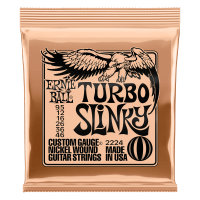
I personally think that lighter gauges have a better tone, especially with the lower register notes. Granted, in my waver, a teeny bit. But there's still more note aspect with the thinner gauge strings to my ears. So for standard tuning, for example, now I use the Turbos, which is a 9.5. I know that sounds douchey, but after one of my friends who's an absolutely savage guitar player, Andre Nieri, he recommended me try it. Nines were always too squirrely for me, just a little bit too light where it's like my bends and vibrato get a little ... Like I have to pay a little bit more attention than I'd like to make sure I don't overbend or just going too wide.
10s would chew my hands up if I hadn't been practicing for like a couple of weeks. Andre's like, "Try nine-and-a-halfs, man." And I was like, "Really?" He's like, "Trust me." And then I did it. I was like, "All right, you're right. This is sick." So that's what I use in standard now. And then anything below that, like D standard or drop G on the seven-string or drop F-sharp, I just use 11s on there. The 11-58, I think is that one.
There's definitely a reason why there's not more people that can play guitar like this, because it takes a lot of work and consistency to even just get to that point to where it's just maintenance. What's the point of playing faster? It's like, I already have so much headroom. It's like that is the cool thing about being able to play guitar at speeds like that, is it makes everything underneath of that that much easier. If you have this ceiling that you know you can hit ... I don't know, I'll start arbitrary number of like, I don't know, 16th notes at 300 BPM. Totally ridiculous. You don't need to be able to play that fast, but everything underneath of that is just going to feel that much easier, because you have that option essentially in your wheelhouse.
Once you reach that level where it's like, "Hey, now I got the technique now. I got it down. And now, I just got to make sure I don't lose it." Because playing guitar at these kind of speeds and cleanliness technique, it is a little sportsman like for sure. Because a good analogy is like going to the gym, where it's like if you don't go for like a week or two, it's going to be a big difference when you come back. You're not going to be as strong, everything's going to be harder, you're going to have less endurance. You're going to have to get back that little bit that you just lost.
So for me at least, after I'd been taking lessons for ... It was around like two and a half years I think with Matt, it got to a point where he was like, "Dude, if I'm going to be honest with you, I can keep giving you lessons and we can just keep doing weirder and more obscure theory stuff. But when it comes to technique, you're just at a point now where you're just going to keep improving and maintaining on your own. So I think it might be more beneficial for you to go take classical guitar lessons or from a jazz guy, and just start branching out."
"Because now that you have the technique of all this crazy metal shred stuff, you're pretty much set up to go investigate anything else that you want, because you have the foundation of the mechanics there to where it'll be easy to adapt, do something like this, or like finger picking for classical guitar, or start learning more obscure theory things and just things about jazz and fusion and playing, and all of that kind of stuff." So that's the turn that I took.
Even though my project with Luke is technically a solo record, it's still very collaborative. Even if I start it, flesh the whole song out, programmed drums is a starting point for him to hear, to be able to embellish on and do his own thing with, there's a handful of songs and parts where he's given me drum parts first and then I write to that. Even still doing all the mixing and mastering with Taylor Larson, getting to work with him and his ideas and just learning a ton from him from the mixing and production aspect. And even the All That Remains record that just came out earlier this year, my favorite tracks on that one are the ones that were the most collaborative.
How would I describe my playing style? Well, I definitely know how other people would describe it, which is just wankery shred-fest, which there's some of that. I'm not going to lie. There's definitely some of that in there. But it's fun. It's sick to be able to do that. I obviously really like it, but it can't be the only thing that you do. There has to be dynamics. It can't just be only shred the whole time, because then it just gets stagnant and boring and old. And it's like, "Okay, when's it going to change? When's something else going to happen?" Two examples off the top of my head, my songs 'Hose Down' and 'Untendinitis', they have a lot of up and downs throughout the whole song. So that way, when those crazy moments do happen, it's got dynamic to it and it's a more of a wow shock-factor thing, and not just a stagnant thing the whole time.
Yeah. I never thought I'd have my own signature Music Man. That's for sure, 100%. Especially the concept of being the second artist on their roster to ever have a seven-string Music Man, is also still a strange concept for me. Because it's just something you never think is going to happen. You're doing your thing, you're just playing guitar, practicing, you just love it. And then right place, right time, right emails, right messages, just everything just starts to just seem like falling in line. There is that saying, "Don't meet your heroes." I think JP's definitely a good exception for sure. I can definitely say I don't agree with that statement, for sure. Because now, he's a close friend. I've taught at every single one of his Guitar Universe camps. He's been five of them now. Tosin and I have been like this ... Mainstays that have made it to everyone.
He asked me to come open for Dream Theater in Europe in 2019, so I got to do that. That was crazy. Shows were awesome. That was one of the coolest venues I've ever played, this place in Sicily called Teatro Antico. Definitely didn't say that right. But it's on a mountain cliff in Sicily overlooking this lake and it's literally ruins. You're playing an old tiny Colosseum-looking thing. One of the coolest shows I've ever played personally, and that was opening for Dream Theater in 2019 with just me and Luke on stage. So that's also another thing, you never ever, when you start playing out and saving up for your favorite guitar player's guitar, when you're a teenager, you ever think is going to happen.